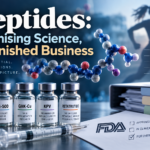
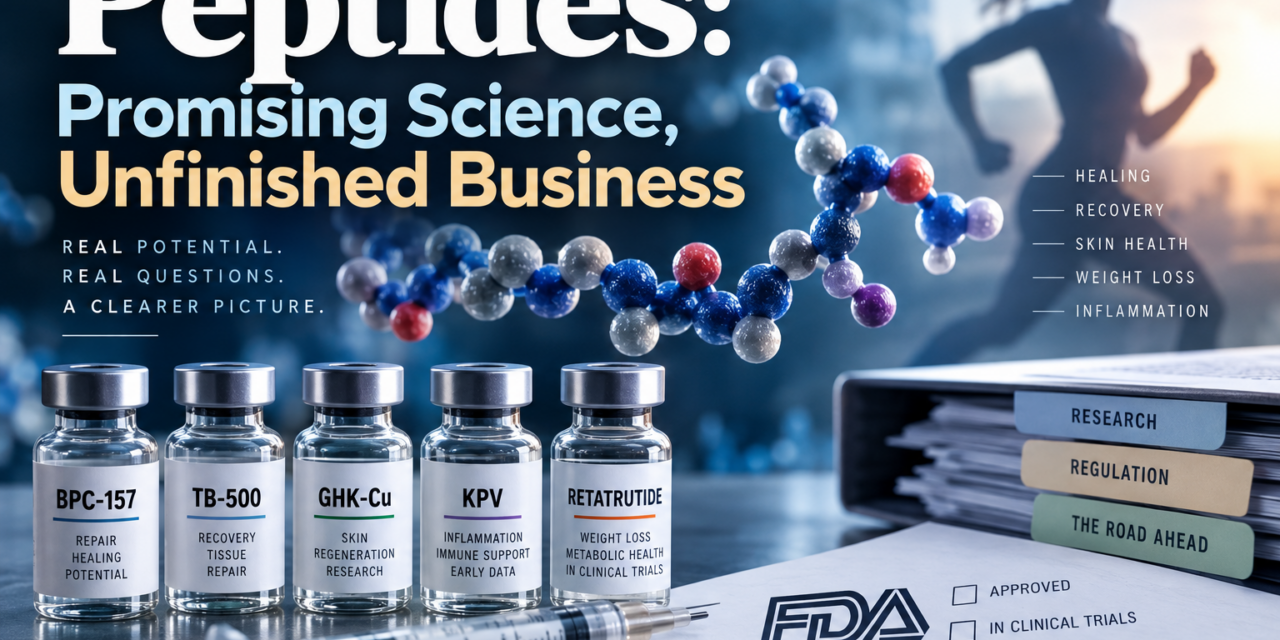
If you’ve spent any time on health podcasts, fitness forums, or social media lately, you’ve heard about peptides. BPC-157 for injuries. GHK-Cu for skin. Retatrutide for weight loss. People are ordering them online, injecting them at home, and swearing by the results.
Some of the research behind these compounds is genuinely exciting. Much of it is also early, thin, and done mostly in rats. Before you buy anything, it’s worth understanding what peptides actually are, what the science does and doesn’t show, and why most of the popular ones are not FDA-approved.
What Is a Peptide?
A peptide is a short chain of amino acids, the same building blocks that make up protein. The difference is length. Proteins are long, folded chains of hundreds or thousands of amino acids. Peptides are short, usually somewhere between 2 and 50.
Your body makes thousands of them. Insulin is a peptide. So is oxytocin. So is GLP-1, the gut hormone that drugs like Ozempic and Mounjaro are built to mimic.
What “Signaling Molecule” Means
Most peptides don’t build tissue. They carry messages.
Think of your cells as a huge office where nobody can walk over to anyone else’s desk. Peptides are the text messages. A cell releases a peptide, it travels to another cell, and it binds to a receptor on that cell’s surface, like a key fitting a specific lock. When it fits, the receiving cell acts: release a hormone, reduce inflammation, build new blood vessels, burn stored fat, feel full.
That specificity is why researchers get excited. If you can send the right message to the right cell, you can steer a very specific process without flooding the whole body with a blunt chemical.
It’s also why peptides are tricky. Most break down quickly in the body, and most get digested if you swallow them. That’s why many are injected.
The Popular Ones
BPC-157
BPC-157 is a 15-amino-acid chain based on a fragment of a protein found in human gastric juice. In animal studies it has shown effects on tendon, ligament, muscle, and gut healing, apparently in part by promoting new blood vessel growth. That’s why it’s popular with athletes and people recovering from injuries.
The problem is that human evidence is limited to a handful of small studies. There are no large, controlled clinical trials. It is also banned by the World Anti-Doping Agency as a substance with no approval from any health authority, so competitive athletes who use it risk a failed test.
TB-500
TB-500 is a synthetic fragment of thymosin beta-4, a protein found in nearly every cell in the body. It plays a role in cell movement and repair, which is why it’s marketed for muscle recovery and connective tissue healing. The lab and animal work is interesting. The human data on the TB-500 fragment itself is very limited.
GHK-Cu (Copper Peptide)
GHK-Cu is a tiny three-amino-acid peptide bound to copper. Your body makes it naturally, and levels drop as you age. This one has the strongest real-world track record of the group, mainly as a topical ingredient in skin care, where research supports benefits for collagen production and wound healing. You’ll find it legally in plenty of serums and creams. Injecting it is a different matter, with much less evidence behind it.
KPV
KPV is another three-amino-acid peptide, a fragment of a hormone called alpha-MSH that helps regulate inflammation. It has shown anti-inflammatory effects in animal models of gut inflammation such as colitis. Human research is essentially nonexistent.
Retatrutide
Retatrutide belongs in a different category. It isn’t a wellness-world peptide. It’s a pharmaceutical drug developed by Eli Lilly and put through large, rigorous trials. Where Wegovy targets one appetite-related receptor (GLP-1) and Zepbound targets two, retatrutide targets three: GLP-1, GIP, and glucagon.
The results are striking. In Lilly’s trial data, people taking the highest weekly dose for 80 weeks lost nearly 30 percent of their body weight on average, roughly 70 pounds. One leading researcher compared that to the results of bariatric surgery. Scientific American
It is still not approved. As of September 2026, retatrutide remains investigational, and Lilly reportedly plans to file for approval in early 2027, with no guarantee of approval. Anything sold online as “retatrutide” today did not come from Lilly. You don’t know what’s in the vial. Incarenow
Retatrutide also makes an important point. Peptides can become real, approved medicine. Semaglutide and tirzepatide are peptides. This is the path that gets there: years of large human trials, manufacturing standards, and FDA review.
Where the FDA Stands Right Now
This is where a lot of online coverage gets it wrong.
In 2023, the FDA placed many of these peptides on a restricted list that effectively barred compounding pharmacies from making them, citing safety concerns. In 2026 that began to change. On April 15, 2026, the FDA removed BPC-157 and eleven other peptides from that restricted category. Then in July, an FDA advisory committee voted 8-6 to recommend allowing BPC-157, KPV, and TB-500 to be compounded. PharmExec
Here’s what that does not mean:
- None of these are FDA-approved drugs. The votes are recommendations that the substances be added to the list compounding pharmacies may use with a prescription, not approvals. PharmExec
- It isn’t final. The FDA is not bound by the panel’s recommendation, and any change requires a formal rulemaking process. PharmExec
- The FDA’s own scientists disagreed. Before the meeting, the agency’s career reviewers recommended against every peptide on the agenda.
- It doesn’t make online “research peptides” legitimate. Products labeled “for research use only, not for human consumption” are sold that way for a reason.
The Real Risks
The biggest risk usually isn’t the peptide itself. It’s everything around it.
- Purity and contamination. Gray-market peptides are often made overseas with no oversight. Independent testing has found underdosed vials, wrong compounds, and bacterial contamination.
- Sterility. You’re injecting this. A non-sterile product can cause serious infections.
- Unknown long-term effects. Most of these compounds have never been studied in humans over years.
- The blood vessel question. Some of these peptides are touted for promoting new blood vessel growth, which helps healing. Researchers have raised the theoretical concern that the same effect could help existing tumors grow. It hasn’t been proven either way, which is the point.
- Immune reactions. The FDA’s original concerns included the possibility of the body mounting an immune response to these compounds or their impurities.
If You’re Considering Peptides
- Talk to a physician who knows this area, not just an influencer or a telehealth sales page.
- If you move forward, use a licensed compounding pharmacy with a prescription, not a “research chemical” website.
- Be skeptical of anyone promising dramatic results from compounds that have mostly been tested in animals.
- If you want the approved version of peptide science, it already exists. GLP-1 medications are peptides with years of human data behind them.
The Bottom Line
Peptides are one of the more interesting frontiers in health science. The signaling concept is real, the animal research is intriguing, and at least one peptide class has already changed medicine. But “promising” and “proven” are not the same thing. For most of the peptides people are buying today, the human research simply hasn’t been done yet.
Stay curious. Stay cautious. And know what’s in the vial before it goes in your body.
This article is for informational purposes only and is not medical advice. Consult a qualified healthcare provider before starting any new treatment.