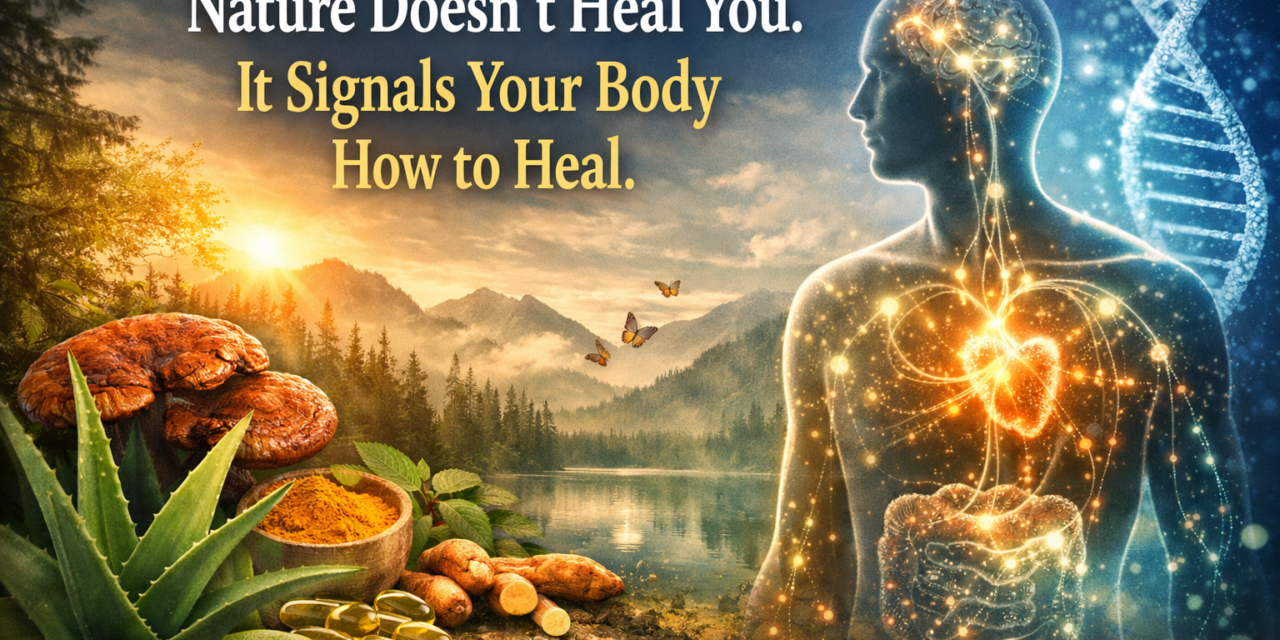
For generations, we’ve been taught to think of natural remedies as healing agents.
Take this herb for inflammation.
Drink this tea for digestion.
Use this plant for recovery.
But what if that entire way of thinking is incomplete?
What if nature doesn’t actually heal anything?
What if…
nature simply tells your body what to do—and your body does the healing?
The Real Healing System Has Always Been You
Your body is not passive.
It is constantly:
- Repairing damaged tissue
- Fighting off pathogens
- Regulating inflammation
- Rebuilding muscle and bone
- Maintaining balance across billions of processes
Every second of every day.
Healing isn’t something you “get” from the outside.
It’s something your body is already programmed to do.
The real question is:
What turns those healing systems on—or off?
Nature as a Signaling System
Plants don’t come with instructions printed on them.
They contain compounds that interact with your biology—triggering responses.
Not forcing. Not replacing.
Signaling.
These compounds:
- Activate immune cells
- Influence inflammation pathways
- Support cellular repair mechanisms
- Communicate with your microbiome
- Regulate metabolic responses
In other words:
Nature doesn’t do the work.
It tells your body to do the work better.
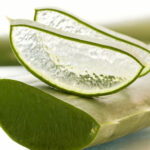
Aloe Vera: More Than a Soothing Gel
Most people think of aloe vera as something you use after the damage is done—like a sunburn.
But aloe isn’t just a topical remedy.
Inside the plant is a compound called acemannan, a long-chain polysaccharide that plays a key role in how aloe interacts with the body.
Acemannan doesn’t “heal” your skin or your gut directly.
Instead, it:
- Activates immune cells like macrophages
- Supports tissue repair processes
- Helps regulate inflammation
- Influences gut activity and microbial balance
That familiar soothing effect?
It’s not aloe doing the healing.
It’s your body—responding to a signal.
Mushrooms: Training the Immune System
Medicinal mushrooms like reishi, shiitake, and lion’s mane contain compounds called beta-glucans.
These don’t act like pharmaceuticals.
They act more like trainers.
Beta-glucans:
- Bind to immune receptors
- Activate macrophages and natural killer cells
- Help regulate—not overstimulate—the immune response
That’s why mushrooms are often described as immune modulators.
They don’t push your immune system into overdrive.
They help it respond more intelligently.
Turmeric: Guiding Inflammation, Not Just Reducing It
But that label misses the bigger picture.
Curcumin interacts with key signaling pathways like NF-κB, which plays a central role in inflammation.
Instead of simply shutting inflammation down, it helps:
- Regulate inflammatory signals
- Prevent chronic overactivation
- Support balanced immune responses
Because inflammation isn’t the enemy.
Uncontrolled inflammation is.
Omega-3s: Resolving Inflammation, Not Blocking It
They help your body finish the job.
They are converted into signaling molecules called resolvins and protectins, which:
- Tell the body when to stop the inflammatory response
- Promote tissue recovery
- Support cellular healing
This is a critical distinction.
Your body needs inflammation to heal.
But it also needs to know when to turn it off.
Omega-3s help deliver that message.
Vitamin D: A Hormonal Signal, Not Just a Vitamin
It functions more like a hormonal signal.
Produced in response to sunlight, it influences:
- Immune regulation
- Bone metabolism
- Cellular growth and repair
- Gene expression
Low levels don’t just mean “less vitamin D.”
They mean less signaling for critical biological processes.
The Shift That Changes Everything
When you stop thinking in terms of “healing substances” and start thinking in terms of biological signals, everything changes.
You begin to ask better questions:
- Not “What cures this?”
- But “What signals is my body missing?”
- Not “What should I take?”
- But “What does my body need to function properly?”
This is where natural health becomes more than a list of remedies.
It becomes a system.
Where This Leads Next
Aloe vera is a perfect example of this principle in action.
Most people use it.
Very few understand it.
In the next article, we’ll break down:
Acemannan — the key compound inside aloe that signals your body to heal
- What it is
- How it works
- Why most aloe products don’t deliver it
- And how to actually use it effectively
Final Thought
Nature isn’t magic.
And your body isn’t broken.
The truth sits somewhere in between:
Your body already knows how to heal.
Nature just reminds it.